The case file
Canvas starts this lesson with courtrooms and paperwork. Same idea here: nobody believes “those angles match” just because it looks that way.
Your job in 01.07 is to prove two kinds of things:
- Twins across an X (vertical angles) are congruent.
- When two roads stay parallel and a bike path cuts both, certain corners match — or add to 180°.
The forbidden move: you cannot prove a theorem by quoting the theorem. If the question is “prove vertical angles are congruent,” “because they’re vertical” is not allowed.
Twins across the X
Two lines cross. Four angles. The ones that sit across from each other are vertical. They share a vertex, they do not share a side (they are nonadjacent), and they are congruent.
Tap a numbered corner on the picture. Its twin lights up with it.
Tap 1, 2, 3, or 4 on the drawing.
Prove the twins without saying “twin”
Canvas walks this as a two-column proof. Here it is as peeling off a shared neighbor.
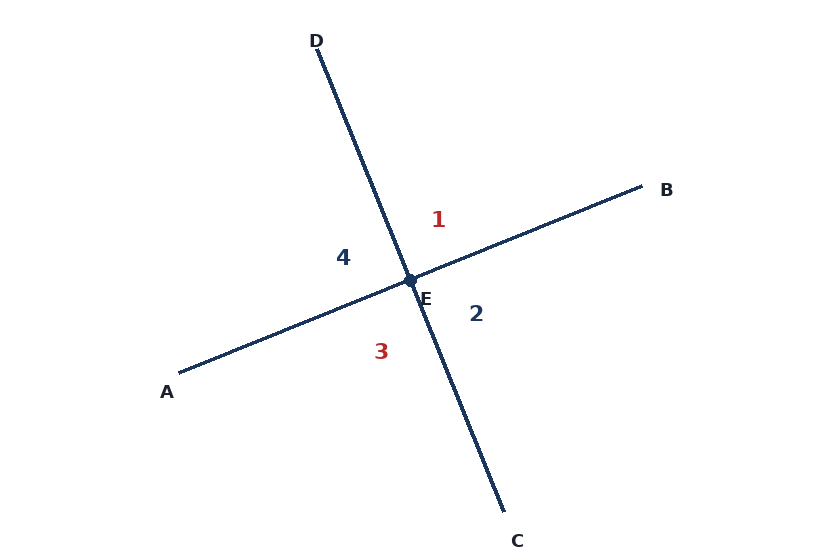
∠1 and ∠2 make a straight line → they add to 180°.
∠3 and ∠2 make a straight line → they also add to 180°.
So both pairs equal 180°. That’s the Transitive Property: two things equal to the same thing are equal to each other.
Now subtract the shared neighbor ∠2 from both sides. What’s left is m∠1 = m∠3. Definition of congruent angles: ∠1 ≅ ∠3.
Eight corners, three letters
Two parallel streets. A diagonal bike path. Eight corners. Canvas names four theorems. The cheat codes:
Tap F, Z, or C — the matching corners light up on the picture. You can also tap a numbered corner.
- F — corresponding. Same side of the bike path, same “slot.” If the streets are parallel, they match.
- Z — alternate interior. Inside the streets, opposite sides of the path. The Z. They match.
- C — same-side interior. Inside the streets, same side of the path. They add to 180° (supplementary), they are not congruent (unless each is 90°).
Alternate exterior is the Z on the outside: opposite sides, outside the streets. They match too.
The four theorems (if the streets stay parallel)
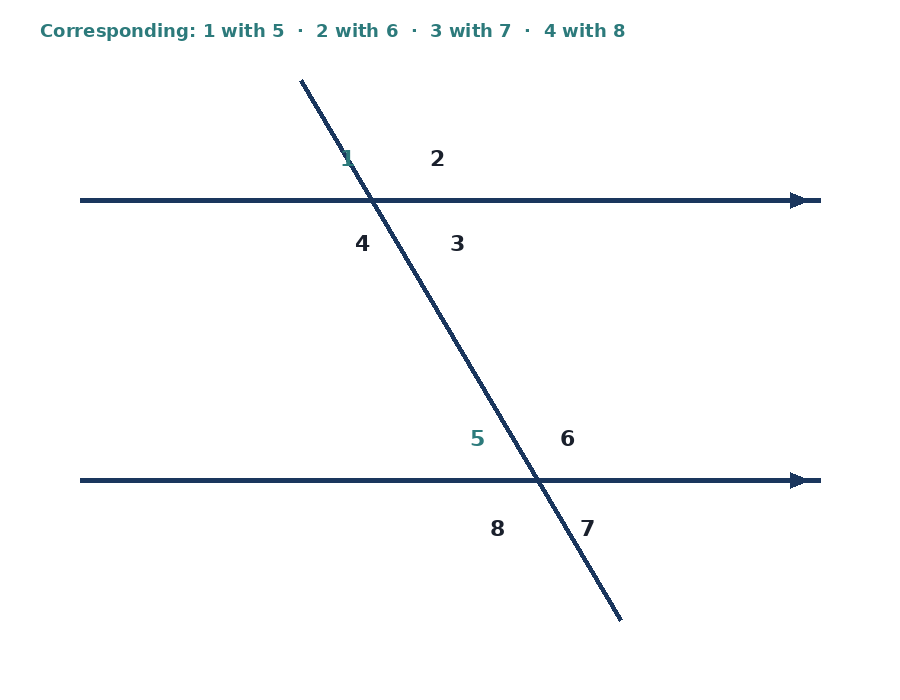
Corresponding Angles Theorem. Transversal + two parallels → corresponding angles are congruent.
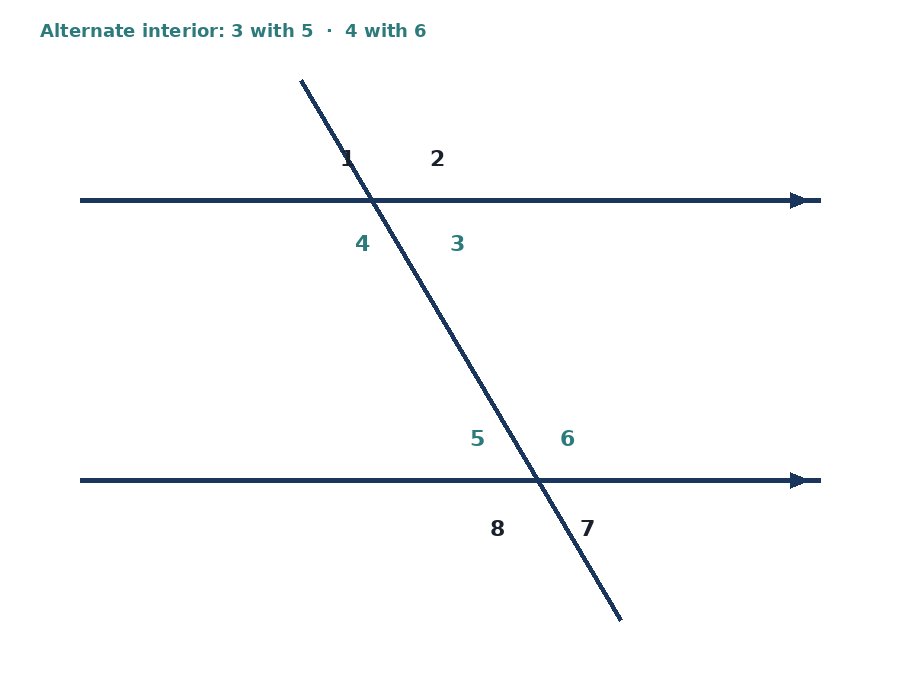
Alternate Interior Angles Theorem. Those inside, opposite-side angles are congruent.
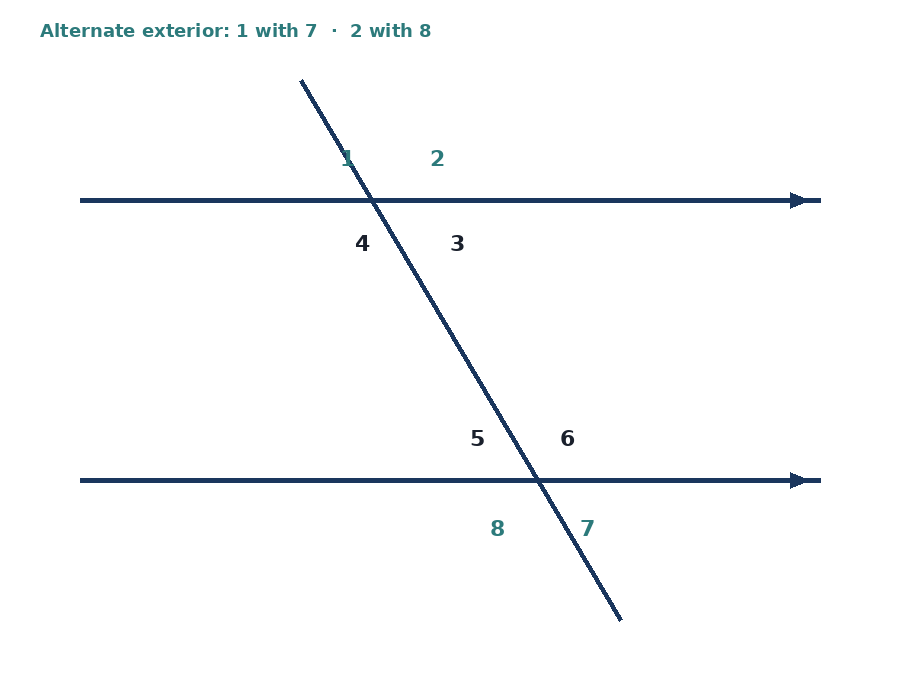
Alternate Exterior Angles Theorem. Outside, opposite-side angles are congruent.
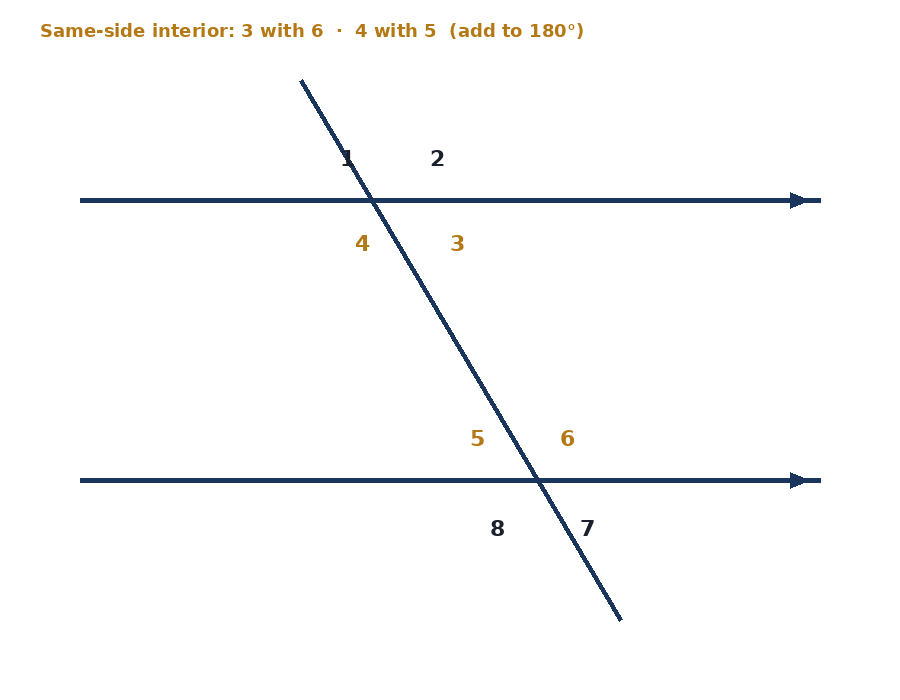
Same-Side Interior Angles Theorem. Inside, same-side angles are supplementary (add to 180°).
If you only know one angle, these four let you fill in the other seven.
Build the corresponding-angles case
Canvas proves corresponding angles using a straight line, angle addition, and same-side interior. Story version:
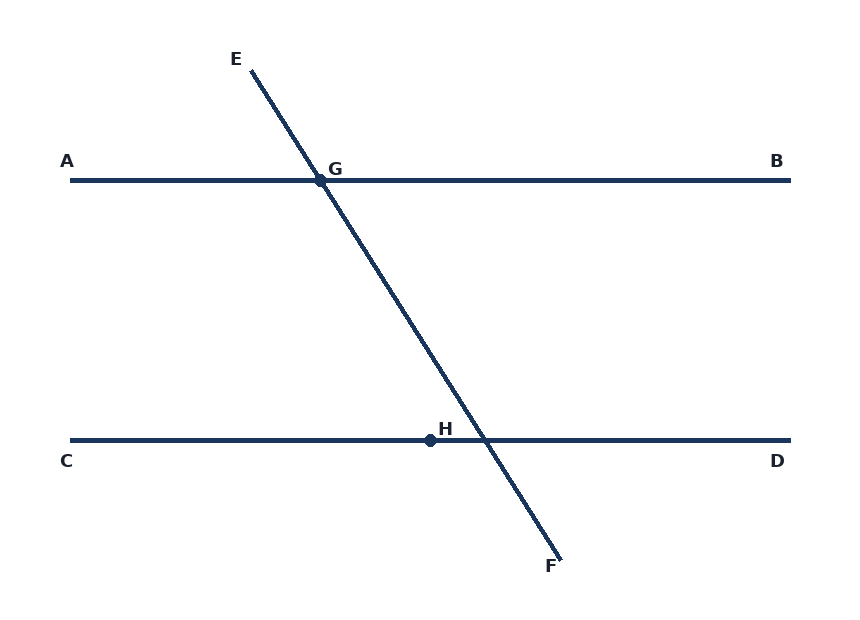
Given: AB ∥ CD. Prove: ∠AGE ≅ ∠CHE.
Both of those angles sit next to the same leftover angle ∠AGF, and both pairs make 180°. Subtract the leftover. The two you wanted are equal, so they are congruent.
m∠CHE + m∠AGF = 180° (same-side interior)
Subtract m∠AGF from both → m∠AGE = m∠CHE → congruent.
The Z is a shortcut
Once corresponding angles are proven, alternate interior is a two-step hop:
- ∠AGF ≅ ∠EGB because they are vertical (the twins you already proved).
- ∠EGB ≅ ∠EHD because they are corresponding.
- So ∠AGF ≅ ∠EHD by the Transitive Property (A matches B, B matches C, so A matches C).
That’s the whole Alternate Interior Angles Theorem. Vertical + corresponding + transitive.
Your turn — pick the reason
Same practice story as the lesson: AC ∥ GD, m∠CBE = 60°, m∠BFG = 120°. Prove ∠BED ≅ ∠BFG.
Watch for lookalike theorems and for “same 60°, different why.”